One Flat Tire Away: The Reality For Working Families in Our Community

May 5, 2026

One Flat Tire Away: The Reality for Working Families in Our Community

By: Ashley Hershberger


Around Holmes and Wayne Counties, people are doing what they’re supposed to do.
They’re working.
They’re showing up.
They’re trying to get ahead.


And still, far too many of our friends and neighbors are one flat tire, one home repair, or one unexpected bill away from falling behind.


At United Way Wayne and Holmes Counties, we hear this story all the time… from families, employers, school staff, churches, and local businesses. The problem isn’t effort. It’s that when something goes wrong, there’s just not much wiggle room.


Who Is ALICE?


You might hear our team talk about ALICE. It sounds like data, but it’s really the people we know: coworkers, parents from ball practice, folks sitting next to us at church and our own family members.


ALICE stands for Asset Limited, Income Constrained, Employed.


In plain terms:
people who are working, but still can’t quite afford the basics.


That includes things like housing, food, transportation, childcare, and healthcare.


Here’s what that looks like in our community:


Holmes County

  • 31% of households are ALICE
  • 9% live in poverty

Wayne County

  • 26% of households are ALICE
  • 11% live in poverty


That means 40% of households in Holmes County and 37% in Wayne County are living at or below the basic cost of living.

These families aren’t avoiding work. Many are working full‑time, sometimes multiple jobs, and still making tough choices:


  • Fix the car or pay the electric bill
  • Buy groceries or fill a prescription
  • Pay for childcare or turn down a better job


That’s not bad decision‑making.
That’s a math problem.


What Household Survival Budgets Tell Us


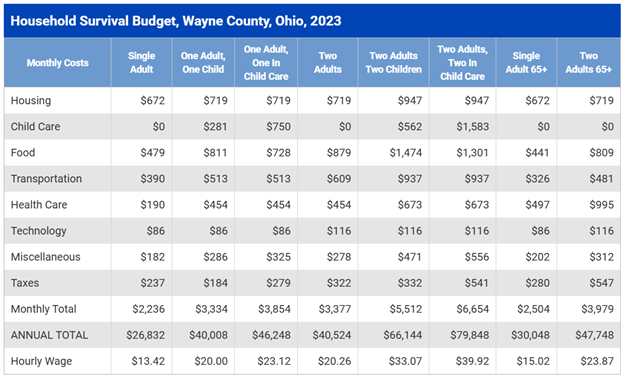
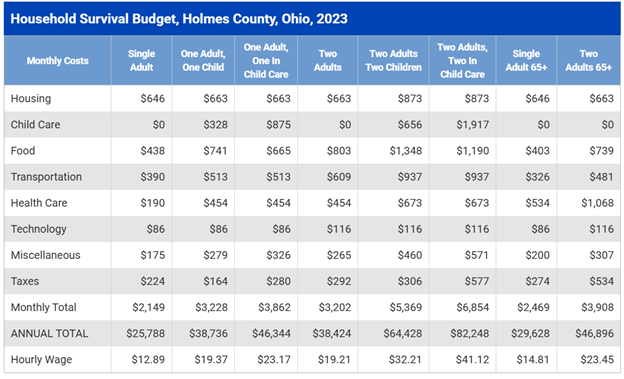
United Way uses Household Survival Budgets to understand what it actually costs to live. Not get ahead, not save… just cover the basics.

When you add it all up (rent/mortgage, utilities, food, childcare, gas, healthcare, and taxes) a lot of working families simply don’t earn enough to keep up. Wages haven’t kept pace with real life costs, especially in areas like ours where getting to work often means getting in a car that you yourself are responsible for.

That’s why so many hardworking people fall into the ALICE category, even while doing everything “right.” (See example budgets below)
Source: www.unitedforalice.org

This is where United Way’s Employment Resource Fund (ERF) comes in.


The ERF is simple by design. It helps people get a job, keep a job, or move into a better job by covering small, work‑related expenses that often come at the worst possible time.


We’re talking about things like:

  • Work boots, uniforms, or scrubs
  • Tools required for a job
  • Certification or licensing fees
  • Emergency car repairs so someone can get to work


Help is usually up to $500 total per person. Not huge money, but often just enough to keep someone working.

If and when someone is able, they may give back by volunteering or repaying the fund once they’re steady again. It’s neighbors helping neighbors, and then paying it forward.


Wayne County’s Story


This fund isn’t new.


In Wayne County, the Employment Resource Fund has been helping working adults for decades.

It all started back in 1987, when an adult education student, Dr. Jonnie Jill Phipps, saw classmates struggling to afford gas, tools, clothing, even haircuts. She made the first donation to help.


Over time, the fund grew. It was cared for by local schools and agencies, then later moved to the Wayne County Community Foundation, where it is still housed today. The fund is now administered by United Way, with guidance from a local steering committee made up of community members.

Because of that strong foundation, the Wayne County ERF has already helped hundreds of people stay employed and move forward.

It works because it’s:

  • Fast when timing matters
  • Practical and focused on work
  • Local and community‑led
  • Respectful of people’s dignity


Many folks think of it like a community savings account. Money set aside to help working people when they hit a bump in the road.


Now, We’re Bringing The ERF to Holmes County


While this model has worked in Wayne County for years, the Employment Resource Fund is new to Holmes County.

The Holmes County Employment Resource Fund is being built by our team at United Way to help in those moments, when one small expense could snowball into a bigger problem.


These aren’t big bills.


But at the right time, they can mean the difference between staying on the job or falling behind.  (See example budget below)


Local Businesses See This Firsthand


Local businesses often see these struggles long before a form gets filled out or a phone call gets made.


At Holmes Tire in Millersburg, a flat tire or unexpected repair is rarely “just car trouble.” For many working folks, it’s the difference between getting to work or calling off, keeping hours or losing them. Standing at the counter, you can feel the weight of that moment, the worry about how to pay, the stress of what missing work means, the quiet hope that there might be a solution.


I’ve watched grace show up there while I was waiting in line to pay my own bill. Someone explaining their situation. A business choosing to work with them instead of turning them away. And the visible relief when a problem is solved. Not perfectly, not permanently, but enough to keep moving forward. Enough to get to work tomorrow.


Through a new partnership with Holmes Pest Control, we see that same care play out in a different setting. They regularly encounter working families dealing with a tough season. When they can, they look for ways to help, and are now offering reduced services for those who qualify through the Holmes County Employment Resource Fund.


What matters is this: these businesses still have to run strong, sustainable operations. They’re not acting out of obligation, they’re not dishing out handouts, they’re acting out of commitment to their neighbors and their community.


And when businesses, United Way, and the community work together, those moments of help add up to something bigger. People staying on the job, families staying stable, and a community that takes care of its own.


If This Sounds Like You, Here’s What to Do


If you’re reading this and thinking, this is me, I am ALICE… you’re not alone.


If you’re working and hit a rough patch, United Way can help connect you to support.


Email: info@uwwh.org
Call:
2‑1‑1 or (330) 263‑6363


We’ll listen, talk through what’s going on, and help connect you to the right help… quickly, privately, and with respect.


How You Can Help


This work only happens because people care about their community.

You can help by:

  • Donating to the Employment Resource Fund
  • Holmes County
  • Wayne County
  • Sponsoring the fund as a business or organization
  • Offering services or reduced pricing as a local partner
  • Simply sharing this information with someone who might need it


Sometimes the solution isn’t a big program.


Sometimes it’s help showing up right when it’s needed… keeping someone working, a family steady, and our community strong.


That’s why these funds exist.
That’s why United Way shows up.
And that’s why this work matters, to all of us.
By Kayley Cox June 2, 2026
Give With Confidence: How United Way Protects Every Dollar Part of our process at United Way Wayne and Holmes with grant application management is to verify that all nonprofits or organizations applying for funding are in good standing. And part of that process is doing your research and due diligence. “Good standing” can be subjective, so we have a standard criteria that we follow, for organizations applying for funding. We verify that each organization must be: - “In Compliance” with the Ohio Attorney General - “Active” with the Ohio Secretary of State - Ranked on third party watch sites, Candid and Charity Navigator. Why is this important you ask?? During my first year of managing grants at UWWH, we had a local organization apply for funding. I did my due diligence, looking up their information on each of the above sites. The first red flag: the organization was NOT in compliance with the Ohio Attorney General. We get it, it happens, maybe there is a staffing change and the new manager of this information wasn’t passed the memo. BUT there were additional red flags. The second red flag: the organization name that was applying for funding did NOT match their Employer Identification Number (EIN) that was legally filed. This can happen when an organization changes their name, but they would still have to register as a “DBA” (Doing Business As). It is my job to make sure I’m looking into this. The third red flag and biggest red flag: the organization was applying for funding for transportation... and after digging deeper into the organization, I found out that this organization was breeding dogs and delivering them to people who purchased them as a fundraiser for the “organization.” I know, I know. Sounds crazy, but this is a TRUE STORY. We do not fund puppy delivery. THIS is why it is important for us to trust but verify. THIS is also why we encourage people to donate to United Way. We are verifying and vetting this information, so you can be sure the Wayne and Holmes County organizations we fund are doing the work they say, both efficiently and effectively. And if something doesn’t feel quite right, we check it out. By law (Ohio Charitable Trust Act and the Ohio Charitable Organizations Act), nonprofits must be registered with the Ohio Attorney General . The OAG is responsible for protecting charitable assets and donors. Annual registration State/Annual report must be submitted to keep “In Compliance” with the OAG. The Ohio Secretary of State is responsible for a nonprofit’s legal existence as a corporation, keeping information on the nonprofit’s legal name, statutory agent, & whether the organization is “Active” or dissolved. If a nonprofit becomes inactive or is canceled by the state, it can: - Lose eligibility for grants - Lose tax exemptions - Be unable to enter contracts or operate legally Rankings on third party watch sites provide additional resources that help verify each organization’s information. Candid collects and verifies data on U.S. nonprofits using IRS records (Form 990, 990‑EZ, 990‑PF), Federal and state compliance data, and direct reporting from nonprofits themselves. Candid shows whether a nonprofit: - Is currently recognized by the IRS as tax‑exempt - Has had its status revoked or reinstated - Eligibility to receive tax‑deductible donations Charity Navigator is another resource we use to verify information because it: - Helps as an additional financial screening and identifies governance red flags - Compares charities within the same cause area - Assesses accountability and transparency practices - Has information in one spot that helps makes quick, informed giving decisions Stories like this are exactly why our vetting process matters. It protects donors. It protects the community. And most importantly, it ensures that resources go to organizations in Holmes and Wayne Counties doing the work they promise to do.  When you give to United Way Wayne and Holmes, you can give with confidence. Join us in supporting programs that are accountable, transparent, and changing lives right here at home. Text WEHELP To 44-321 or go to https://secure.givelively.org/donate/united-way-of-wayne-and-holmes-counties-inc
By Kayley Cox April 6, 2026
The Day Off That Opened My Eyes I took the day off to chaperone my son’s Kindergarten field trip: fun, sweet, and honestly pretty exhausting. After dropping him back at school, I ran to the grocery store. At the checkout, the cashier asked how my day was going. I laughed and told her I was a little tired from keeping up with a group of five-year-olds all day at the field trip. She smiled and said she understood. She had recently retired from a local school district, and then she shared something that made me pause. Despite having worked all those years, she couldn’t afford to stay retired. She was still too young for Medicare, and health insurance premiums were simply unaffordable without additional income. Even with Social Security survivor benefits from her late husband, she was struggling to get by. So, she returned to the workforce. And she’s not alone. Far too many older adults are finding themselves in similar positions: forced back into work not because they want to, but because our systems leave them with no choice. Rising healthcare costs, gaps before Medicare eligibility, and limited fixed incomes mean many retirees simply cannot cover their basic needs. This wasn’t just a conversation in a grocery store checkout line. It was a reminder that the people who spent decades serving our communities, teaching, caregiving, supporting essential services, often face their own unseen challenges. We can do better. We have to do better. If this story resonates with you, here are a few meaningful ways you can help create change: 1. Support organizations helping older adults access healthcare and financial stability. United Way Wayne and Holmes partners with dozens of local nonprofits to support seniors who have nowhere else to turn. 2. Advocate for policies that protect affordable healthcare, strengthen Social Security, and support aging with dignity. Your voice truly matters. 3. Check in on retirees in your life. A simple “How are you really doing?” can make all the difference. 4. Get involved. Volunteer, donate, or share this message. Every action counts! Our older adults deserve more than scraping by. They deserve dignity, stability, and the ability to enjoy the retirement they worked for. Let’s work together to make that a reality.  For information about how to donate to help our Older Adults in Wayne and Holmes, go to uwwh.org, email us at info@uwwh.org or call (330) 264-5576.
By Kayley Cox March 5, 2026
You Don’t Know, What You Don’t Know At United Way, one of the most meaningful parts of my job is helping community members discover the resources that already exist to support them. Holmes and Wayne Counties are filled with compassionate organizations and services ready to help, but too often, people simply don’t know where to start. That’s where WHIRE/211 comes in. And although 211 has been in our community for over 60 years, many people still have no idea it exists. If you’ve never heard of 211, you’re not alone. It’s one of the most powerful tools we have, and yet, I constantly hear these same reactions when I mention it: “Wow, I had no idea.” “This was so informative.” “I wish I knew this sooner.” 📞 What Is 211? 211 is our local, 24/7 resource hotline. With just one call to 211 or the direct line (330) 263-6363, you’re connected to a live, compassionate operator who can guide you to essential services in our area. Whether you’re looking for: 🥫 Food assistance 🏠 Housing support 💼 Workforce development 🧠 Mental health services 🚗 Transportation help 👶 Childcare options …or any other community resource, 211 is your starting point. And the best part? It’s anonymous and available 24 hours, 7 days a week, 365 (or 366 if leap year) days a year. 💬 Why Awareness Matters I’ve spoken at schools, met with nonprofits, and presented to local businesses. And every time, I’m reminded of how powerful awareness can be. People are genuinely surprised to learn how much help is just one phone call away. So many resources that our own community members don’t know exist. That’s why spreading the word about 211 is so important. Whether you’re a community leader, a neighbor, or someone simply looking for help, knowing about 211 can make all the difference.  📣 Help Us Share the Message If you’ve used 211, tell someone about it. If you haven’t, save the number. And if you’re part of a group, organization, or business that serves our community, consider inviting United Way to share more about how 211 is a free resource right in our community. To schedule a brief presentation or meeting about WHIRE/211, contact me at kayley@uwwh.org Because you don’t know what you don’t know, but now that you do, share it. The more we know, the more we can help, and the stronger our community becomes.
Show More